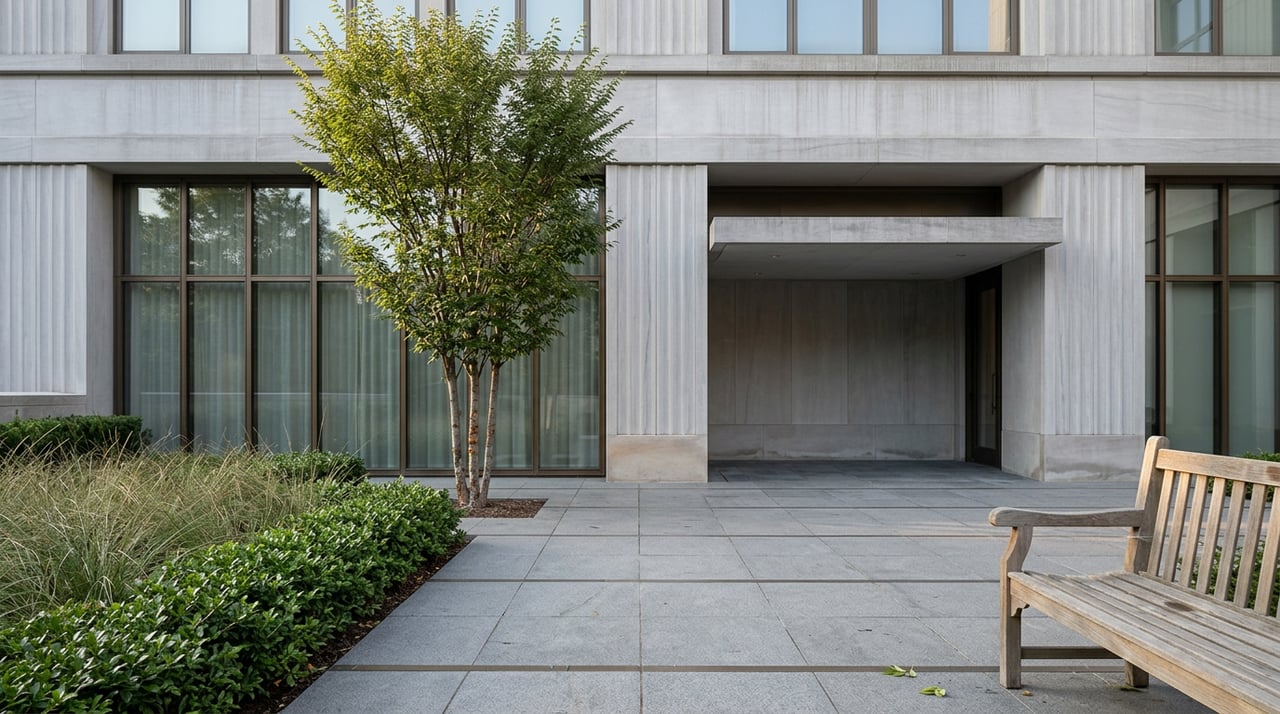
A buyer touring two condo towers on the same Manhattan block this spring will find nearly identical apartments: same square footage, same prewar-adjacent finishes, same doorman shift schedule. Then the offering sheets come out, and the common charges are $400 a month apart. Ask why, and most listing agents will shrug toward inflation, insurance, or "the market." The real answer is sitting in a board resolution neither building is required to hand a buyer until an attorney asks for it by name.
That answer is Local Law 97, New York City's building emissions law, and 2026 is the year it stopped being a planning exercise and started showing up as an actual number on actual bills.
The Bill That Wasn't There Last Year
Local Law 97 sets a hard cap on carbon emissions for most buildings over 25,000 square feet, which covers the overwhelming majority of Manhattan's condo and co-op stock. Buildings that exceed their cap pay $268 for every metric ton of carbon dioxide equivalent they emit above the limit, every single year they stay over. There's no ceiling and no forgiveness for a good year. A building running 200 metric tons over its cap owes roughly $53,600 annually, on top of whatever it already spends heating, cooling, and staffing the property. Run the same math against a bigger, older tower and the number moves into six figures fast.
The Department of Buildings' own program page puts the citywide reach at roughly 50,000 buildings, the majority of which are large multifamily co-ops and condos rather than office towers. This was never a commercial-only law. It was written for exactly the kind of building most Manhattan buyers are looking at.
What changed in 2026 is enforcement. The first annual reporting cycle, covering each building's 2024 energy usage, closed out in 2025, and the city has spent this year turning that filed data into real Notices of Violation rather than warning letters. Boards that spent the past two years debating whether to act are now voting on how to pay.
Where the Money Actually Comes From
A board facing an LL97 bill has three places to put it: raise common charges or maintenance across the building, pass a one-time assessment, or borrow against the property through a refinance or line of credit. Most boards are using some combination of all three, layered with rebates from Con Edison, NYSERDA, or NYCEEC where they qualify.
For a buyer sitting across from a board package this year, the practical result is a 4 to 8 percent maintenance increase tied directly to Local Law 97 in the buildings that are over their cap. It doesn't arrive labeled as a carbon fine. It shows up as a line item called something like "carbon assessment" or "Article 320 charge," tucked into the same monthly statement as the elevator contract and the landscaping bill. Unless someone knows to ask what Article 320 refers to, it reads like ordinary cost creep.
The Buildings Feeling It First
Not every Manhattan tower is exposed equally, and the pattern isn't random. The buildings showing up over their cap most consistently share a profile: built before 2000, running original gas-fired boilers and central air, carrying full amenity floors and round-the-clock staffing that adds electric and mechanical load a leaner building doesn't have. That combination shows up heavily in the corridor of condo towers running from around Lincoln Center down through the Upper East Side, where a wave of full-service buildings went up in the 1970s through the 1990s with systems designed decades before anyone was thinking about a carbon cap. Buildings in that category are frequently running 15 to 25 percent over their 2024 emissions limit.
Contrast that with newer construction built to more recent energy codes, which tends to clear its cap comfortably and will keep doing so even as the limit tightens again in 2030. Two buildings can sit three blocks apart, built forty years apart, and carry entirely different carbon exposure that has nothing to do with the view or the finishes and everything to do with what's behind the mechanical room door.
The Two Documents That Tell You Which Building You're Actually Buying
Before signing a contract on anything over 25,000 square feet, a buyer's attorney should be requesting two specific pieces of paper: the building's most recent benchmarking submission and its emissions filing through the city's BEAM portal. Both are free for a board to produce, and a board with a clean compliance record generally hands them over without hesitation. Hesitation itself is information.
Once those documents are in hand, the questions that matter are less about the current year and more about the trend line:
- What is the gap between the building's actual emissions and its 2024-2029 cap, and how does that gap change once the stricter 2030 limit takes effect?
- Has the board voted to fund a decarbonization plan, or is the carbon assessment showing up in the budget with no engineering scope behind it?
- If the board is relying on a Good Faith Effort filing to delay full penalties, has the required work actually been completed, since that pathway loses its protection retroactively if the promised retrofits don't happen?
Board meeting minutes are usually where this conversation is actually happening, well before it reaches the maintenance statement. Language like "decarbonization study," "engineer scope," or "LL97 capital assessment" appearing in minutes without a corresponding funding vote is a building still arguing with itself about how to pay. The same language paired with an approved budget line is a building that has already made its decision, for better or worse.
What the Market Is Already Doing With This Information
New York is not a state where a seller can simply decline to answer a direct question about a pending assessment or a known violation, and a buyer's attorney will find a Notice of Violation in a lien search regardless of whether anyone volunteers it. That means the information asymmetry here is temporary. The market is already starting to close it.
Buildings with a clean emissions filing and a credible plan for the 2030 cap are holding their pricing. Buildings carrying a violation with no visible plan are seeing 3 to 6 percent price reductions relative to comparable units nearby. That's not a hypothetical discount for future risk. It's a repricing that's already happening this year, building by building, as attorneys start asking for BEAM filings as a matter of routine rather than an unusual request.
There's a second layer compounding this for financed buyers. Fannie Mae and Freddie Mac tightened their condo lending rules this spring, and one of the changes taking effect this August narrows the streamlined review process that many buildings previously relied on, pushing more transactions into a fuller review of the building's finances and reserves. A board already carrying an unfunded LL97 retrofit is exactly the kind of finding that full review is designed to surface, which narrows the buyer pool for that unit regardless of how the apartment itself shows.
Citywide, a 2023 REBNY-commissioned study projected that Local Law 97 penalties across covered buildings could climb past $900 million a year once the 2030 cap takes effect. That's not a number any single buyer needs to carry in their head. What it signals is that the gap between compliant and non-compliant buildings is set to widen, not narrow, as the cap tightens again in 2030 and buildings that squeaked by this year fall further behind.
A Few Straight Answers
Does this apply to co-ops the same way it applies to condos? Yes. The size threshold and the penalty structure don't distinguish between ownership types. A co-op board facing an LL97 bill has the same three levers as a condo board: raise maintenance, pass an assessment, or borrow against the building.
What if the building I'm looking at is under 25,000 square feet? Buildings below that threshold generally fall outside the direct emissions cap for now, though it's worth confirming exact square footage against the city's records rather than assuming, since additional buildings on the same tax lot can push a smaller building into coverage.
Is a carbon assessment the same thing as a special assessment for something like a roof or facade? Not necessarily, though boards sometimes bundle them. Ask specifically whether a line item is tied to Local Law 97 compliance or to an unrelated capital project. The two carry different timelines and different odds of recurring.
The gap between a well-positioned Manhattan tower and one carrying quiet carbon exposure isn't visible from a listing photo or an open house. It's visible in two documents most buyers never think to request. If you're comparing buildings this fall and want a second set of eyes on what a board package is actually telling you, Irene Sarri is a good place to start that conversation. Let's Connect.